examples – 13 – shifting of borders in the Muellerhouse – german occupation
shifting of borders in the Muellerhouse – occupation by the german Wehrmacht
In 1919, the Treaty of Versailles formally ended World War I, and Alsace and Lorraine were reintegrated into French territory. B. Müller, daughter of Lisbeth and Henri Müller and a telephone operator by profession, married Charles Schneider in 1920. The entire family—whether French communists or Prussian militarists, unionists or nationalists—was still united at this wedding. Like B., Charles worked at the Rombacher Hütte and was an accountant by profession. B. and Charles were now naturalized French citizens and Schneider became the head of the household at the Muellerhouse.
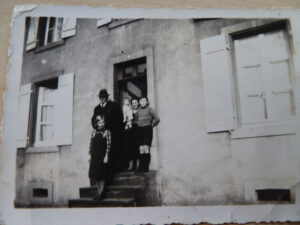
Auguste Wurtz, the brother-in-law—pictured here with B. and her children at the Mueller house – is a communist and supports the workers’ strikes at the steel mill. He served as the elected mayor of Rombas from April 1934 to May 1935.
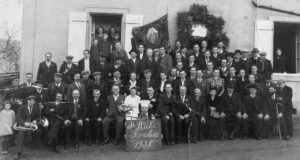
(Photo on the right) In November 1938, Schneider hosts the feast of St. Barbara, the patron saint of miners and steelworkers at the Mueller house.
But ever since a referendum successfully orchestrated by the NSDAP in 1935 in the neighboring German Saar region—a coal-mining area from which the steel mill sourced its coke—and the subsequent incorporation into Germany of that territory, which had been under an international mandate since the Treaty of Versailles, a new wind was blowing through the Müller household. Schneider turned his attention to a Germany that was becoming increasingly radical. He became a supporter of the German leader Adolf Hitler and the NSDAP.
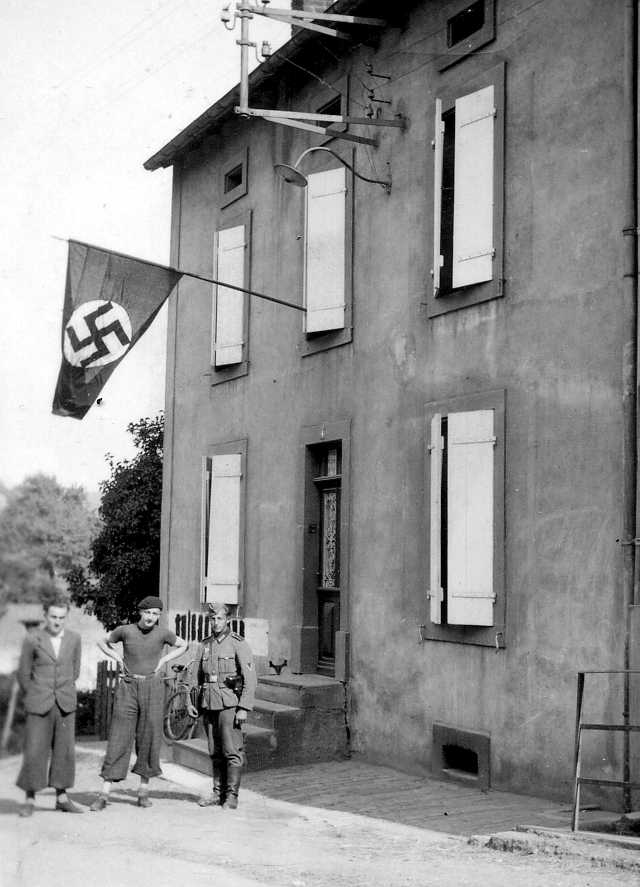
Foto on the right: on June 17, 1940, Schneider flies the swastika flag over the Mueller house. Two days later, the French town of Rombas is occupied by the German Wehrmacht. As a collaborator with the German occupiers, Schneider will betray his neighbors and colleagues to the Gestapo.
Auguste Wurtz joins the French Resistance. He becomes a member of the resistance group “Group Mario” and survives the Queuleu SS special camp in the city Metz as well as the German concentration camp.