method – 11 – How do you figure out the things you don’t know?
If we have no proof and no evidence, we must observe for a long time and also follow the inner path—exploring what lies stored within us as memory and the traces that exist out there. We begin to search. I have to work with my intuition. I write something down. I take it out again. The matter won’t let me rest all night. The next morning, I look for the scrap of paper in my “Experiments” folder—which I set up specifically for this purpose—and insert it again, and so it goes on and on. You feel your way as if through fog and work against resistance you don’t understand. I write, listen, take notes, and archive. I organize the material into categories, work with recurring themes, develop keywords, and in this way discover the concepts that have persisted across the decades—concepts that, as I come to realize, play a role and revolve around a reality I cannot yet see. A search in the archives can yield surprising results.
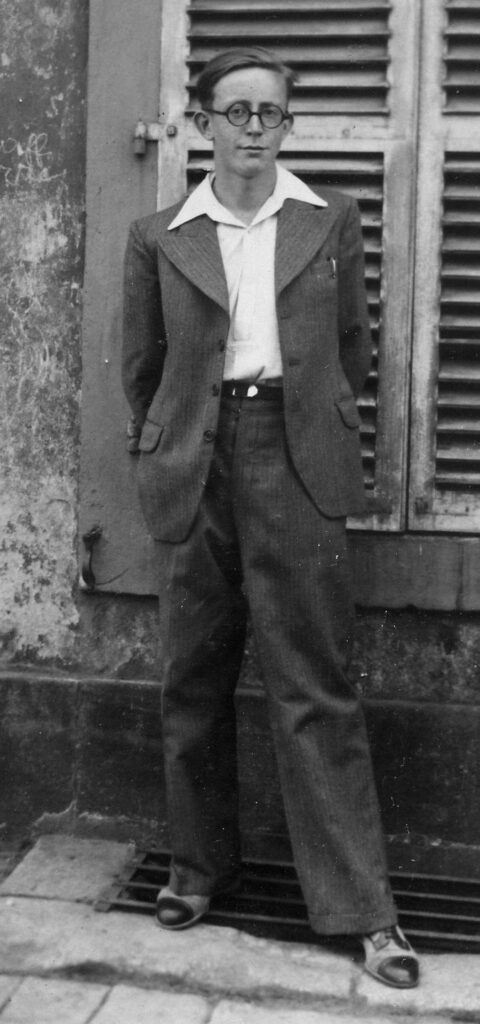
In the photo: The fact that this young Frenchman would become involved in the coming years with the 33rd SS Waffen Grenadier Division “Charlemagne”—a major unit of the Waffen-SS during World War II—only came to light through the 1948 ruling of the Tribunal Militaire de Metz, which I happened to find in an archive. No one in the family had ever spoken about it. He was a Nazi and an anti-Semite, and later a supporter of the Front National, a postwar far-right French party that is now known as the Rassemblement National (RN). The photo was taken in France in 1937.